Wednesday, April 6, 2011

Trip Experience to Monticello and Fallingwater

The experience of this trip was very enlightening and came at perfect timing.  I was very inspired by both of the houses we toured.  The first house was the home of one of our most historic presidents Thomas Jefferson.  The name of his house is Monticello.  Mr. Jefferson was very intelligent and a talented man.  He constantly kept Monticello under renovation, and is quoted as saying "...architecture is my delight, and putting up, and pulling down, one of my favourite amusements."  This can be seen throughout touring the Monticello home, full of original artwork and inventions.  The next house we toured and my personal favorite between the two was Fallingwater, located at Bear Run, PA.  Fallingwater was originally a home that was designed for the famous Kauffman family.  They needed a new vacation home and employed architect Frank Lloyd Wright to do the job.  Mr. Wright delivered to them something new to the architectural scene and is now held as one of the most recognized and toured homes of the nation.  Upon arrival to Fallingwater it is out in the woods out of site from the main road.  It is a building that is very in touch with nature and blends in with its landscape like it is apart of it.  The home is constructed over a beautful waterfall and is comparable to dresser drawers located in the mountain sliding out at different distances. 

Reading Response 11

Blog Post 11 Modernism: Style and Substance

Examples of Art Deco influencing architectuPicture Source: http://www.casasugar.com/Art-Deco-548440re                                
Villa Savoye showing all five rules of modern architecture by Le Corbusier
The rise of modernism has evolved over time.  Different movements taking place progressed its dominance into what we see in today's architecture and mainstream.  Rules have been made and broken and after viewing the different movements and the buildings and objects that were apart of these particular styles, people have been  always craving and wanting something new, but it really is something old but transformed and reinterpreted differently.  Kind of like fashion trends, and the saying that if you hold onto something long enough, eventually it will come back as a reformed trend or revived.  When I think of modernism I think of clean and simple lines, something very streamlined and without heavy ornamentation or too much color.  Anything basically that would date the object or space.  One timeless building that comes to mind when I think of a terrific example of modernism in architecture would be Villa Savoye in Poissy, a suburb of Paris, France. Built in 1929 by  Le Corbusier, an architect who got his start at an exhibition. Le Corbusier created a building with such timelessness and classic elegance that it holds as a staple to most if not all architecture lectures for future generations of designers.  Modernism helped get its start at these exhibitions another ingredient that helped push the envelope for the strive to find Modernism.  These exhibitions would let people see the newest and latest in everything from art, to new foods, and different cultures.  These exhibitions would draw people in from all over, and each time architecture changed its look and rules of what was most modern and new with the competition of countries to be the newest .  When looking at Villa Savoye it demonstrates the Five Points that Corbusier  stated as a means to new modernism.  The first is the use of pilotis, (elevating the mass from the ground).  The second is a free plan  When viewing the building it is hard to tell the date when it was built, because it looks as though it could have been constructed today in modern design. With the Art Deco movement following behind the Art Nouveau and Secession movements we see how designs have evolved.  Art Nouveau which can still be seen much throughout Europe was all about entertwining nature with design.  After the Art Nouveau movement we saw the emergence of the Secession Movement, which was very similar to the Art Nouveau style with its whiplash curvature detailings of objects found in nature.  Which at the time seemed like something new, but it harkened back to the rules and was similar to the building styles of the ancient Greeks.  Secession also incorporated streamlining and was all about materiality.  Some examples of the Secession movement and the buildings that were constructed during this time would e the Secession building designed by joseph maria olbricht.  and the Palace Stoclet, designed by Joseph Hoffman in Vienna Austria.  The arrival of the Art Deco movement came from l'exhibition de arts d`ecoratifs in Paris France around 1928.  With this exhibition performers and artists dressed in costumes and did very intricate dancing.  Their costumes were made of  geometrical patterns, circles being the main shape that took front stage center during the Art Deco movement.  All of these happening factor into and influence what we call modernism.  Designers today work hard to be modern to create the latest newest things, while also maintaining a timeless elegance in their work, so it can be viewed at anytime or date and still look amazing.  For example the Chrysler building in New York will always remain timeless and catch the eye. 

Reading Response 10

Blog Post 10

Reading Response 9

Blog Post 9

Reading Response 8

Reading Response 7

Blog Post 8

Monday, March 14, 2011

Blog Post 7: Comftorable Spaces (History and Theory of Design)

 
On this day we were to find spaces that are to be considered happy spots for us on campus.  From all the different spots visited, I chose this courtyard behind the Weatherspoon Art Museum.  This spot brings special memories for me when I first moved to Greensboro.  My first visit to this space was during the summer, when flowers were in full bloom.  It makes for a pleasant and peaceful spot for me with all the greenery and sculptures.  When I step into this space it is a full experience for the senses and it always inspires me in some way.  There is the fresh air lightly blowing and tickling the hair on my skin, the smell of plants and nature in the air fills my lungs.  There are also many places my vision catches as I examine my surroundings and take in every little detail from the brickwork patterns to the layout of the space and its sculptures and awesome gate entrance.  The sound system that changes periodically with different sounds, such as crickets fill the air which brings back memories of summer nights when I would leave my window open while sleeping and could hear the peaceful chirps of crickets in the night.  I am a lover of nature and all things involved with gardening which influenced my decision on this particular space.  It is like stepping into another world, you almost lose yourself in the space and forget for a moment you are on campus safely enclosed from the outside hustle and bustle of everyday life and traffic in Greensboro. 

Environmental Design II : Color Week Project

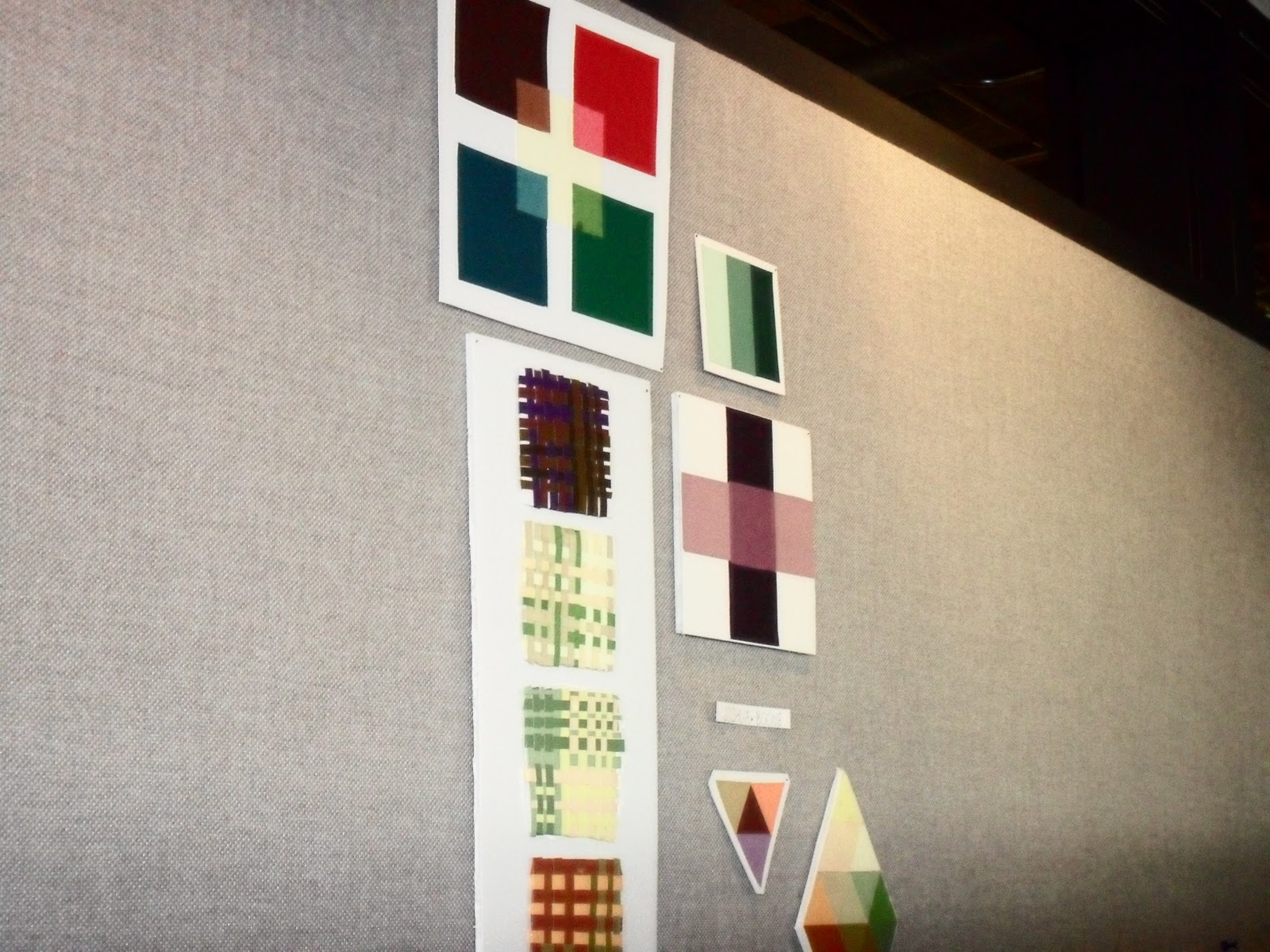
For color week, we were to find color combinations that complimented each other through a series of assignments.  We observed what colors would look like if you were to put a lighter/darker shade of color over the same shade.  Here are some pictures of my designs of the colors I chose to work with. With the first project we were to choose a shade and show how it goes from darkest to lightest with a shade that showed the transition in the middle. Then we did a color chart with carefully chosen hues that went from the darkest area of the color wheel transitioning to the lightest.  The next was a representation of the different seasons.  For this project I decided to go with a weaving technique to tie the colors I used together.  Each box of weaving represented each season.  This project was very fun, and I learned a lot about the color process. Each project was carefully constructed, measured, and cut carefully with an X-acto knife. 

Monday, February 21, 2011

Reading Response 6: Theory and History of Design

Blog Post 6: Theory and History of Design

Structural Differences between the cathedrals in Amiens, France, and Cologne, Germany.  After looking at both cathedrals our group found that they were similar in alot of ways.  There were actually very little difference in the structure.  In Amiens, we found that the building was completed many years before the cathedral in Cologne was completed.  Although the cathedral in France was very focused it seemed on showing off its talents with the inside of the building as opposed to Germany, where the outside was more decorative than the inside.  These differences  could be because of many reasons.  It can be assumed by what was going on with the government and area at the time.  The church played a large part in their societies as being constructed as the largest building in the towns surrounding them.  These cathedrals were probably seen as a refuge from the craziness surrounding the outside as a place to gather and escape from the outside world.  Some of the differences I could see right away were the differences in ornamentation on the exterior, for example the flying buttresses.  The German cathedral had much more filigree and ornamentation on the outside compared to the inside.  The French cathedral was the exact opposite with much more ornamentation on the inside compared to the inside.  Some of the statues on the outside of the German cathedral appeared to have older male figures with beards.  The French cathedral had much younger men without beards with angelic faces on the outside. The difference inside the cathedrals were easily spotted on the view of the ceiling at the crossing.  The German cathedrals ceiling was very basic with its lines, and the French cathedral had a few more lines in its main square at the crossing.  I imagine those were there for extra support of the building.  Both buildings contain the cruciform style.  By German design their cathedrals were all designed with one main tower.  French cathedrals were mostly designed with 2 towers.  After viewing the photos for both cathedrals, you can see that the German cathedral is more pointy and darker in appearance, whereas the French cathedral is more box-like and the stone has a lighter hue to it. 

Wednesday, February 16, 2011

Theory Reading 2 Discussion: IAR 102

For this discussion the class was shown the film Babette's Feast.  A Danish film about elderly sisters, one who wins a lottery of 10,000 francs.  Instead of spending the money on herself, she decides to give back and use the money to create a delicious dinner for her sister and their congregation for the pastors hundredth birthday. The cuisine was supposed to be a very authentic french dinner.  Since such an exotic dinner is full of precious and rich ingredients, the sisters and the congregation feel guilty about indulging in such a feast.  So as an agreement they decide to eat the meal, but not take any pleasure in it, or speak of the meal during the dinner.  The only guest that wasn't there for the agreement and was present for the dinner was the general.  So he became the only one who could comment on the dinner.  He described how great the food was and how it reminded him of Cafe Anglaise in Paris.  Turns out Babette was the old chef of Cafe Anglaise. One quote that stayed in my mind from the film would have to be by the general who commented that the food "was a love affair that made no distinction between bodily appetite and spiritual appetite."  Which makes sense to me because food can be very pleasing not just nutritionally and taste-wise.  It also can be spiritually uplifting and make us feel good, bring back memories of good times, etc.  Relationship to design and culture can definitely be important.  Different cultures have different cuisines, different ways of eating, etc.  All of these factors have to go into thought when planning a dinner, the guests have to be taken into consideration as well as the meal and what utensils will be used with the type of food chosen.  All of these things I have thought about so far for this project, it has proven to be challenging, but also a fun process that has expanded my imagination further in understand the dining experience. 

Theory Reading 1 Discussion : IAR 102

I believe that design is very important in the dining process.  Everything has to be well thought out and planned.  Everything from the dining ware, the setting, table, chairs all the way down to the lighting and music.  All of these things help influence the experience for someone.  Everything that will grab their senses and be delightful.  Design itself can alter a persons mood, conversation, and their overall being.  After writing the paper describing my setting for the dining table and dinner that would take place at it.  All of these things came into play with the story.  Things a normal person who hasn't thought about design would have overlooked in the process.  Through this semester I have learned that design has to appeal to the senses to be incredible and memorable.

Unit Summary 1 : Theory and History of Design

Reading Response 5: Theory and History of Design

Blog Post 4 : History and Theory of Design

Reading Response 4: Theory and History of Design